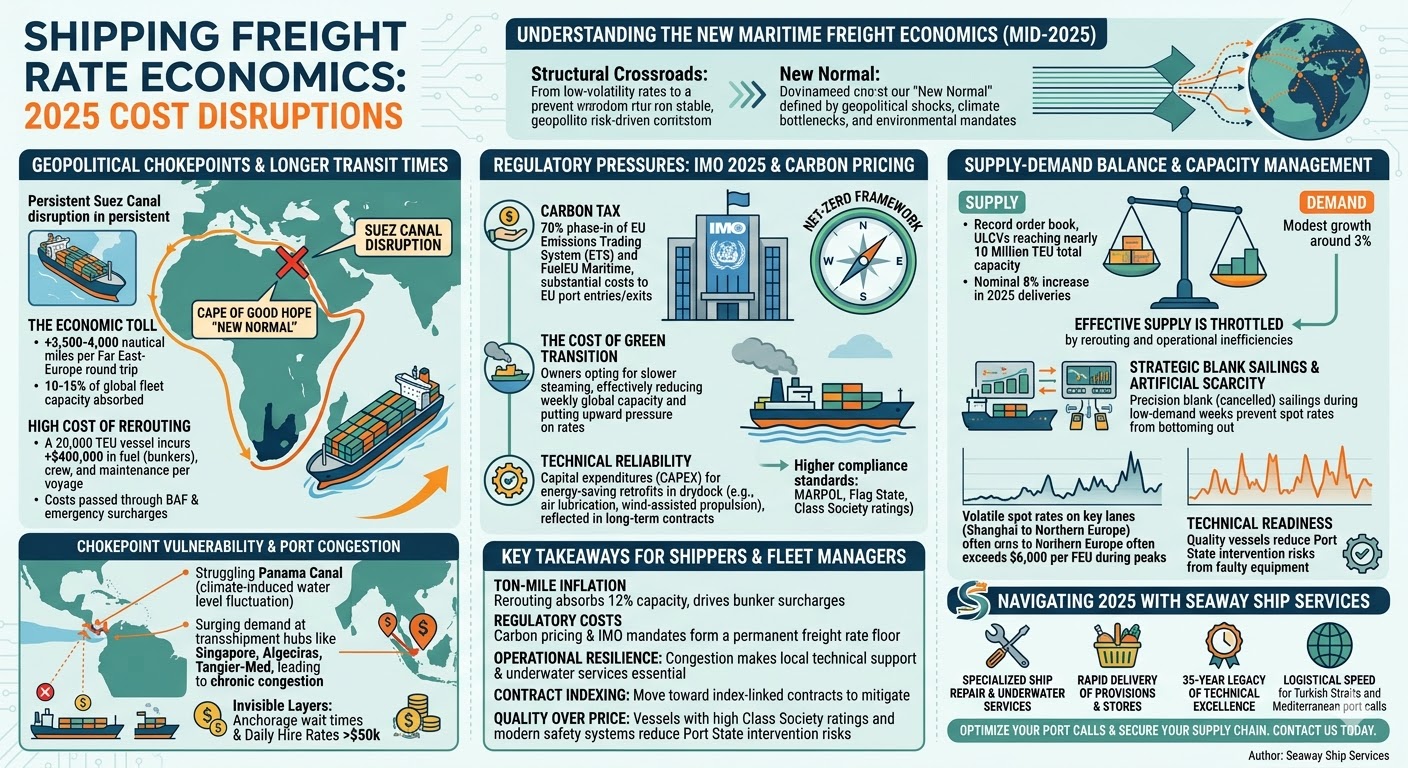
The New Reality of Maritime Freight Economics in 2025
As we navigate through the mid-point of 2025, the maritime industry finds itself at a structural crossroads. The days of predictable, low-volatility freight rates have been replaced by a "new normal" where geopolitical shocks, climate-induced bottlenecks, and aggressive environmental mandates dictate the bottom line. For fleet managers and procurement officers, understanding shipping freight rate economics is no longer just about tracking supply and demand; it is about quantifying risk and resilience across a fragmented global network.
In 2025, the global container shipping market is defined by a paradox of high capacity and high costs. While the order book for new ultra-large container vessels (ULCVs) has reached record levels, reaching nearly 10 million TEU in total capacity, actual effective supply is being throttled by rerouting and operational inefficiencies. This has kept spot rates on key lanes—such as Shanghai to Northern Europe—at levels significantly higher than the 2019 baseline, often exceeding $6,000 per FEU during peak volatility.
Geopolitical Chokepoints and the Cape of Good Hope "New Normal"
Perhaps the most significant reshaper of container shipping costs in 2025 has been the persistent disruption of the Suez Canal. What was initially viewed as a temporary rerouting due to Red Sea instability has become a long-term operational standard. This shift has fundamentally altered the ton-mile math of global trade.
The Economic Toll of Longer Transit Times
Rerouting around the Cape of Good Hope adds approximately 3,500 to 4,000 nautical miles to a Far East-Europe round trip. In economic terms, this equates to a 10% to 15% absorption of global container fleet capacity. The costs aren't just in time; they are in bunkers, crew wages, and maintenance. A typical 20,000 TEU vessel diverting around Africa incurs an additional $400,000 in fuel and operational expenses per voyage compared to a Suez transit. These costs are directly passed to shippers through Bunker Adjustment Factors (BAF) and emergency surcharges.
Chokepoint Vulnerability and Port Congestion
While the Suez Canal remains under-utilized, the Panama Canal continues to struggle with climate-induced water level fluctuations. These overlapping disruptions have forced a reorganization of global hub-and-spoke models. Ports like Singapore, Algeciras, and Tangier-Med have seen a surge in transshipment demand, leading to chronic congestion. When ships wait at anchorage, the daily hire rates—often exceeding $50,000 for mid-size vessels—add invisible layers to the final freight bill. Effective port state control and efficient turnaround times have never been more critical to cost containment.
Regulatory Pressures: IMO 2025 and Carbon Pricing
2025 marks a watershed year for environmental compliance. The IMO (International Maritime Organization) has accelerated its Net-Zero Framework, making carbon intensity a primary driver of vessel value and freight pricing. We are no longer just complying with MARPOL Annex VI; we are navigating a landscape of carbon levies and fuel intensity standards.
- EU ETS and FuelEU Maritime: In 2025, the European Union's Emissions Trading System (ETS) phase-in has hit 70%, adding a substantial "carbon tax" to every container entering or leaving EU ports.
- The Cost of Green Transition: To meet flag state and class society environmental ratings, many owners are opting for slower steaming to reduce emissions. While this helps meet carbon targets, it effectively reduces the world's weekly carrying capacity, putting upward pressure on rates.
- Retrofitting and Technical Reliability: Vessels are increasingly hitting drydock earlier for energy-saving retrofits, such as air lubrication systems or wind-assisted propulsion. These capital expenditures (CAPEX) are reflected in the long-term contract rates offered by major alliances.
The Balance of Supply and Demand: 2025 Market Concentration
Despite the high volume of new vessel deliveries in 2025—estimated at an 8% increase in nominal capacity—market demand growth has remained modest at around 3%. Ordinarily, this would lead to a collapse in freight rates. However, the top carriers have mastered the art of "capacity management."
Strategic Blank Sailings and Artificial Scarcity
Through the use of alliances and digital twins, carriers are now able to implement blank (cancelled) sailings with surgical precision. By withdrawing ships from service during low-demand weeks, they prevent the spot market from bottoming out. For a procurement officer trying to secure provisions or stores for a fleet, this unpredictability in schedules means that inventory management must be more agile, often requiring local partners who can respond to 24/7 changes in vessel ETAs.
Technical Readiness as a Competitive Advantage
Reputable shipping companies are now differentiating themselves through technical reliability. A vessel that fails a port state control inspection due to faulty fire fighting equipment or outdated radio & navigation equipment faces delays that ripple through the entire supply chain. In the high-cost environment of 2025, the "cheapest" freight rate often becomes the most expensive if the vessel is technically compromised.
Key Takeaways for Shippers and Fleet Managers
- Ton-Mile Inflation: Rerouting is the primary driver of cost, absorbing nearly 12% of global capacity and driving up bunker surcharges.
- Regulatory Costs: Carbon pricing (EU ETS) and new IMO mandates are adding a permanent floor to freight rates that did not exist five years ago.
- Operational Resilience: Congestion at transshipment hubs makes local technical support and underwater services essential for maintaining schedules.
- Contract Indexing: More shippers are moving toward index-linked contracts to mitigate the extreme volatility seen in 2024 and early 2025.
- Quality Over Price: Choosing vessels with high class society ratings and modern safety systems reduces the risk of costly Port State interventions.
Navigating 2025 with Seaway Ship Services
In a maritime world defined by disruption and high costs, the reliability of your service partners is the ultimate hedge against uncertainty. Whether your vessel is navigating the Turkish Straits or docking in the Mediterranean, Seaway Ship Services provides the technical excellence and logistical speed required to keep your operations moving. From specialized ship repair and underwater services to the rapid delivery of provisions and stores, we understand that every hour of delay in 2025 is an hour of lost revenue. Our 35-year legacy of serving the global fleet ensures that even in a volatile market, your technical and supply needs are met with precision. To optimize your port calls and secure your supply chain, contact Seaway Ship Services today.

